

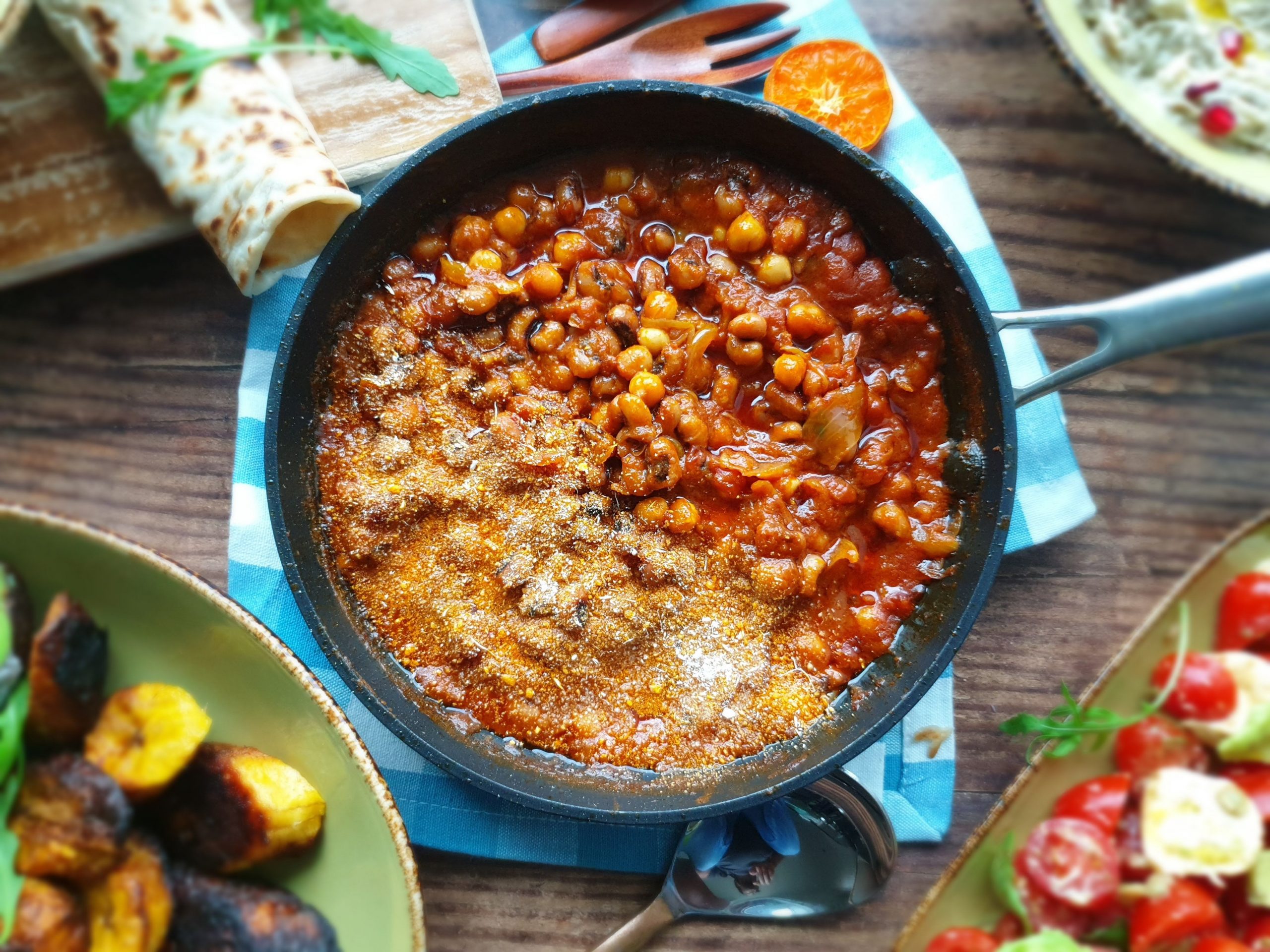
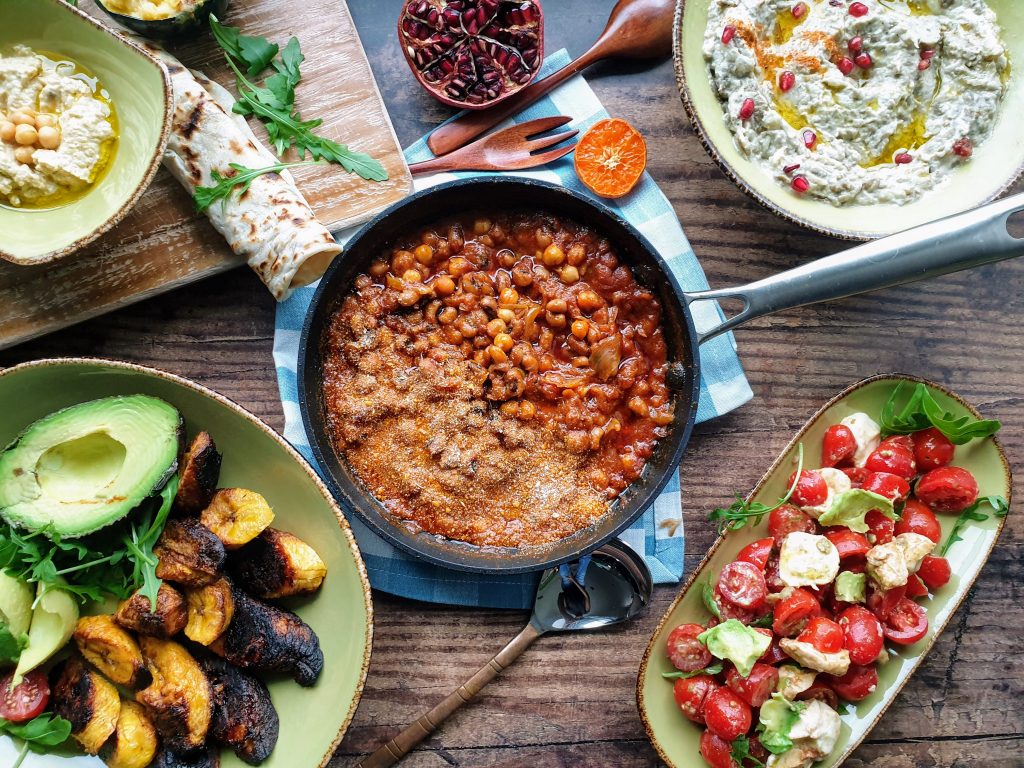
Red red is a Ghanaian bean stew made with black-eyed peas, onions, tomatoes and red palm oil, traditionally served with a side of fried plantains and a sprinkling of gari. For those not familiar with it, gari is a coarse toasted cassava flour. It makes an altogether delightful dish that is perfectly suitable for vegans and vegetarians alike, and is naturally gluten-free. It is one of the simplest ways to experience the flavours of Ghanaian cooking, so if you would like to try something new, have a go at this.
I don’t remember being very fond of red red as a child, but for some reason the older I get, the fonder of it I become. It makes me wonder whether we gravitate towards the things that remind us most of home and our childhood when we are far away. My mother used to make this dish for us, and now whenever I make red red, I think of her. Red red is a truly tasty and comforting dish.
What Ingredients Do You Need to Make Red Red?
You start with palm oil, onions, tomato paste, tomatoes, and beans. You can add garlic, ginger, and chillies as well, then finish the dish with a sprinkling of gari.
Some Variations
Red Red is traditionally a meat-free dish, although there are versions that include salted, smoked, or dried fish, which make flavoursome additions. It can also be cooked with meat like beef or goat, although these additions take it in a different direction from the simple bean stew I know and love.
If you don’t like plantains, try roasted sweet potatoes. Their natural sweetness makes them a lovely alternative to ripe plantains. You can also serve Red Red with rice or chapati.
Black-Eyed Peas or Cowpeas
Black-eyed peas, a variety of cowpeas, are the most common bean to use. White black-eyed peas are very easy to get, hold their shape in the stew, and maintain a satisfying bite. Sometimes I mix them with chickpeas. Canned or dried versions of the beans work beautifully; however, I prefer dried beans for this recipe. In Nigeria, there is a preference for brown cow-peas called oloyin or honey beans. These are very soft and sweet; therefore, if you use them, your stew will have a mashy consistency with delicious sweeter notes. My mother used the red version of cow-peas, and even though I didn’t really know what bean it was at the time, I remember that distinct colour.
It does make me wonder why we call red red, red red.
Why Is It Called Red Red?
There are several theories about where the name comes from. Perhaps it is partly the tomatoes, the red cowpeas and, of course, the deep red palm oil. Or perhaps, according to my mother, we have boarding school students to thank.
Tomato paste became popular when Mama was at boarding school in the early 1960s. This was around the time President Kwame Nkrumah’s administration was investing in local industries, including tomato processing. As tomato paste became more widely used, Mama remembers red red becoming increasingly popular in school kitchens. Her theory is that it was the students themselves who coined the name.
Is that believable? Quite possibly.
I find the story particularly intriguing because, as far as I know, there isn’t a simple English translation of red red that we use as its name in Ghanaian languages. So perhaps the name really did emerge from the everyday language of students and cooks.
I love that there may be several explanations for something as simple as the name of a dish. Food history is often like this: part documented history, part oral history, and part family memory.
What About Gobɛ or Gob3?
Gobɛ or Gob3 is a popular Ghanaian street food made from mixing gari, cooked cowpeas and palm oil. Many enjoy serving it with a side of fried plantains, shito pepper sauce, boiled eggs, and avocado. Considering there are a variety of red red bean stew recipes out there, and some people opt not to use tomatoes, aren’t red red and Gobɛ the same thing? That’s a great question.
As far as I know, gobɛ is a popularised name for yɔ kɛ garri or simply gari and beans. The key difference lies in the preparation. Red red is a stew, while gobɛ is made by boiling beans until soft and mashing. It is generously salted, then palm oil and gari are mixed into the beans. I am now inspired to share more about gobɛ, including an actual recipe, in a separate post.
Red Palm Fruit Oil (Dende)
Palm or dende oil in the context of this recipe is the crude red fruit oil from the oil palm tree, Elaeis guineensis. It has a distinctive, rich, earthy, and slightly nutty flavour. A lot of Ghanaian red palm oil is made by cooperatives of women farmers. I have seen my mother make soup from palm fruits, called palm nut soup. As the soup is cooked, oil settles to the top, and at times, I have seen her collect and save rhe oil. I explain easy ways to buy palm oil in the “Where to get ingredients” section of this post.
The West African Trio: Onions, Tomatoes, Chilies
A great trio of onions, tomatoes and chilies are the start to most Ghanaian stews. Red red is no exception. And the chilies we use are scotch bonnet peppers with a unique flavour and aroma. These days we include ginger and garlic and enrich the stew by adding tomato paste. The stew takes an incredible amount of water, so you will use up about 500ml of vegetable stock and might still need a drop or two of water. You simply can’t make a mess of this dish.
Plantain And Gari (Toasted Cassava Grits)
The last 2 things you will need to complete this dish are plantains and a little bit of gari as a garnish. Fried plantains are the ubiquitous side dish, although I prefer to roast mine. I simply season them and coat them lightly in oil, then place on a parchment paper-lined baking tray. Silicon mats are even better for this. I bake them until golden brown at a high oven temperature.
The addition of gari is quite interesting. This is because it’s made from cassava, a crop originally from South America. And Brazil has a similar cassava-based ingredient called farofa, often used like gari. Some sources claim our West African gari is something learned from South America through returnees from Brazil; this is a plausible claim. However, gari is always presented as a compliment to red red; with a dusting of gari on the side. It adds a textural crunch to the dish. Gari has many other uses in West African cooking, which I am happy to share in due course.

Where To Get Ingredients For Red Red
Ingredients for Red Red, including red palm oil, black-eyed peas, oloyin (honey) beans, gari and plantains, are much easier to find than they used to be.
If you’re in the UK, look for them at Afro-Caribbean and African grocers, as well as some larger supermarkets. In London, markets and shops around Brixton, Peckham, East Croydon and North End Road are good places to start. Plantains are also commonly available at Asian grocery stores.
If you’re further afield, African grocery stores are often your best bet. When I lived in Melbourne, I could find plantains and other African and Caribbean ingredients around Victoria Market and specialist grocers.
If you don’t have an African grocery shop nearby, I’ve put together a few online options below. These are products I would actually use in my own kitchen; some links are affiliate links, which means I may earn a small commission if you make a purchase through them, at no additional cost to you.
Ingredients I Recommend
Mama’s choice: Zomi palm oil
My mother swears by Zomi palm oil for cooking dishes like Red Red.
Black-eyed peas
A good everyday option for making Red Red, particularly if you’re cooking for a crowd.
Oloyin (Honey) Beans
These brown cowpeas are softer and naturally sweeter than white black-eyed peas, making them an interesting alternative.
Gari
Look for toasted cassava flakes rather than fine cassava flour. You only need a small amount to garnish each serving.
Nutritional Information
Red Red is a naturally vegan and gluten-free meal that combines beans, vegetables, plantains and red palm oil.
The beans provide plant protein, fibre, iron and folate, while plantains contribute fibre, carbohydrates and potassium. Red palm oil contains naturally occurring carotenoids and gives the dish its characteristic colour and flavour.
As with any cooking oil, palm oil is concentrated in calories, so I prefer to enjoy it as part of a varied diet, alongside plenty of fresh vegetables.
I love serving Red Red with a simple tomato and fresh herb salad, or alongside dips such as aubergine dip. If you are in Nigeria and can get hold of scent leaf, also known as efirin, try adding some finely chopped leaves to the salad.
Jump to the recipe below or watch our tutorial on YouTube. Red Red, A Ghanaian Bean Stew.
Updated by Freda on 8 August 2026
Red red is a Ghanaian bean stew served with fried plantains. This recipe is simple, wholesome, gluten-free and vegan. Use whole beans and soak them. If you don't have the patience for that use canned beans, the dish is just as delicious. The first step is to pre-cook the beans if you are using dried beans from the market. Ensure they are clean and free of debris, then soak the beans in fresh water for about 2 hours or overnight, this makes the cooking process quicker. You can also soak the beans in hot water for half an hour before cooking. Boil the beans for 30 to 45 minutes until soft. Sometimes it takes longer, but an energy efficient method may be pressure cooking too. I will update on pressure cooking when I try this. If using ready to eat canned beans, you can start from step 2. Now that the beans are ready you can start the recipe. Chop the onions and tomatoes, crush the garlic and grate the ginger. Add the palm oil to a pan and saute the onions until caramelized. Add the tomato paste and fry for about a minute. My mother swears by this in all recipes she uses with tomato paste, to cook off the raw and sour taste. Add the garlic, fry about 30 seconds then add the ginger and tomatoes in and fry until they have cooked down. This should take 5 to 10 minutes. The scotch bonnet peppers can be added with the tomatoes. They are potently spicy so I advise you add them whole with just a prick to regulate the heat. Remove when serving. For heat junkies or the more adventurous, chop up and add half, whole or all two scotch bonnets for mighty fiery flavour. Add the cooked beans and vegetable stock then allow to simmer for half an hour on low heat. During this time you can prepare the plantains. Take 4 plantains. Peel, slice, season with salt and deep fry until golden brown or oven roast for 10 to 15 minutes until golden brown. Serve the dish garnished with a little gari powder. If you do not have easy access to palm oil, try coconut oil if it's in your pantry. A lot of flavour is infused from the oil you use, and palm oil gives this dish that original West African flavour. These ingredients should all be accessible at your local grocery store. To get your hands on palm oil or plantains, try an Afro Caribbean or Asian store, in an organic store like Wholefoods or check online. If you would like to substitute the black-eyed peas for another bean, try chickpeas/garbanzo beans, pinto, aduki or kidney beans or a combination of your favourites.Red Red, Ghanaian Bean Stew with Fried Plantains (Vegan, Vegetarian, Gluten Free)
Ingredients
Instructions
Nutrition
Notes


22 Comments
Sheeda
July 1, 2020 at 4:21 pmThis looks absolutely scrumptious!!! I’ll definitely try this xxx
myburntorange
January 24, 2024 at 8:45 pmI hope you tried it. 😘
Andrew
April 26, 2022 at 9:57 amA couple of questions. When do you add the cooked beans? When do you add the peppers–do you leave them whole or chop them too? When do you add the ginger?
myburntorange
April 26, 2022 at 10:04 amHi Andrew
Thank you for visiting and making great observations on the recipe. Add the beans just before adding the vegetable stock. For the pepper and ginger, i usually grind them with the tomatoes, so these are added at the same time as tomatoes. I will update the recipe. Since writing it I have cooked this recipe with the red and brown cowpea varieties of the black eyed peas. They are sweeter and cook to a much softer bean pottage of sorts. I highly recommend cooking till as soft as you can get them which would take some time unless you have a pressure cooker. I hope that answers your questions without adding too much confusion. Happy cooking 😀
Andrew
April 26, 2022 at 2:28 pmThanks for the clarification…looking forward to giving it a go
Mawusi
August 30, 2022 at 2:52 pmThere’s a vast difference between red red and beans stew. For red red( known as G)be, u don’t need tomatoes paste and the likes. It’s just onions, palm oil and pepper( u can add garlic and ginger to taste.. preferably) and off course the beans. But the recipe u wrote above is for beans stew( u can eat beans stew with any staple .. rice, plantains etc and evenn add beef) but for red red it’s only Eaten with ripe plantains (or u can choose to add egg or pears) thank u
myburntorange
October 31, 2022 at 4:45 pmThanks for taking the time to share YOUR knowledge. I have shared mine 🥰
Adjoa
July 18, 2023 at 3:51 pmThere are different ways to make red red. You described the version most commonly sold as street food, while the recipe on this page is more commonly sold in restaurants and food joints. As for what each individual makes at home, it all depends on the person. Some make one or the other, while others (like myself) make both, depending on which we feel like &/or have time for. MYBURNTORANGE, don’t mind this person.
myburntorange
January 24, 2024 at 8:41 pmHe he yoooooo ❤️
Bobby
October 31, 2022 at 4:42 pmThank you so much for this great recipe Freda! This is my go-to red red recipe. My boyfriend keeps requesting I make it, haha! I have to say using red palm oil made a huge difference in taste for me. I have recently also purchased gari, so I am going to add that too tonight. I also want to compliment you on the beautiful photos included in this recipe, they are stunning!!!
myburntorange
October 31, 2022 at 4:44 pmI am so pleased to hear that 🥰
James
September 3, 2024 at 1:29 amJust made this for dinner, it’s fire🔥 and on my rotation now! Also coconut oil is a great alternative! Thank you for this recipe!
myburntorange
June 14, 2026 at 11:13 amYou are so welcome 🙂
Nina
September 4, 2024 at 8:44 pmIf it is labeled cassava flour, is it the same as gari, or a little different? Thanks.
myburntorange
June 14, 2026 at 11:13 amHi there. Cassava flour is simply flour and is processed in a different way to gari, I also suspect cassava flour is uncooked, whereas gari has been process by grating, fermenting, pressing out moisture then roasting. So gari has the consistency of course sugar or granulated sugar
Nina
September 16, 2024 at 10:20 pmHello Freda,
Thanks for this fun simple recipe. I had a question about gari. I got the yellow gari from a Caribbean grocery store and on the package it says you must cook it first, although it says it is roasted. Should I dry toast it just in case? The brand is Kotoko. Thanks for the help.
Ama
November 15, 2024 at 5:39 pmExcellent recipe, so glad to see more Ghanaian recipes and blogs out there. Made it for my roommates while I’m studying here in UK
Zuri
March 17, 2025 at 6:30 pm452 cals per serving or per whole recipe?
myburntorange
June 14, 2026 at 11:20 amLet me review that, but most likely per portion
Amy Wallace
July 27, 2026 at 11:32 amHi!
Thank you for sharing this, I also loved tour recipe for kelewele. I’m about to leave Ghana and have been trying to find how to make my favourites when I get home.
I have a couple of questions for the red red one above. When you say cook the beans, what does this mean? Do I boil and strain them? Roast them? Fry them? And where is the palm oil added as I didn’t see that in the recipe? Is it used to cook the onions in?
myburntorange
July 27, 2026 at 11:48 amHi Amy
Thank you so much for your thoughtful questions. I take it for granted that people can understand what is zooming past in my brain. I have updated the recipe but to answer your question, you need to pre-soak and boil the beans until they are soft if you are using whole dried beans. Please do not add salt to beans when you are trying to cook them as this makes them hard and difficult to cook. By the time they are cooked most of the water is either gone or really thick. You can drain the beans or use the beans and remaining liquid. Canned beans are a quick fix that I get away with regularly. Simply start at step 2 if you are using canned beans, which are already cooked and soft. You can use the canned liquid or discard if that is your preference. My preference is to use the liquid, its nice and thick and glossy. Hope that helps
myburntorange
July 27, 2026 at 11:51 amHere’s a video I did to help https://www.youtube.com/watch?v=PxI_Ica0OqA